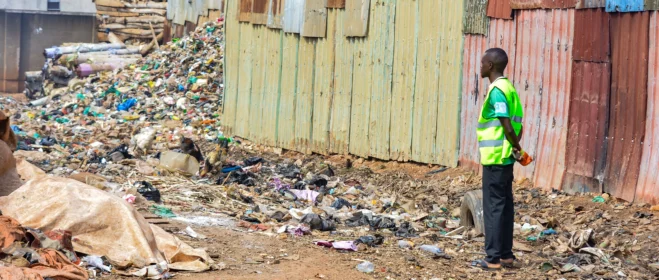
For decades, oil has been presented as Nigeria’s route to economic development. But in the Niger Delta, the communities living closest to extraction have often experienced the opposite: polluted rivers, degraded farmland, gas flaring, damaged health, lost livelihoods, and persistent energy poverty.
That contradiction is at the centre of the JET Voices conversation with Prince Israel Orekha. As Founder and Executive Director of Connected Advocacy for Empowerment and Youth Development Initiative, Orekha works with communities in Nigeria’s Niger Delta to document environmental damage, strengthen youth participation, and push for a locally led just energy transition.
The cost of oil extraction
The environmental damage caused by oil production in the Niger Delta is not anecdotal. In its independent Environmental Assessment of Ogoniland, the United Nations Environment Programme collected more than 4,000 samples from over 200 sites.
UNEP found widespread contamination of soil and groundwater. In at least ten Ogoni communities, drinking water was contaminated with high levels of hydrocarbons, creating a serious threat to public health.
Ogoniland is only one part of the wider Niger Delta, but the findings reflect the kind of environmental injustice Orekha describes throughout the episode. Communities that once depended on fishing and farming now face polluted waterways, damaged agricultural land, abandoned infrastructure, and limited access to reliable electricity.
For Orekha, the central problem is not simply that pollution exists. It is that the people living with its consequences are rarely included in the decisions that shape the region’s future.
“The process starts with the people.”
When fishing and farming disappear
Orekha remembers a time when fishing was part of everyday life in the Niger Delta. Children could go to the river, families could catch enough fish for dinner, and visitors could leave with fish or locally produced food as a gesture of hospitality.
He describes how that way of life has been disrupted by oil spills and pollution. Rivers that once supported entire communities are now filled with dead fish, while farmland has become increasingly difficult to cultivate.
The consequences extend beyond the environment. When fishing and agriculture disappear, young people lose their main sources of income. Some migrate in search of work, while others remain trapped in communities with limited employment, poor healthcare, and unreliable electricity.
This is why Orekha rejects the idea that oil extraction should be judged only by the revenue it generates for the national economy. If the communities that produce the wealth lose their health, land, food systems, and future prospects, then the economic model is not delivering development where it matters most.
Making environmental damage visible
One of Connected Advocacy’s most important tools is visual storytelling. In 2021, the organisation held the Niger Delta Climate Change Exhibition in Benin City, presenting photographs, paintings, and community reports from Bayelsa, Delta, Edo, and Rivers states.
The exhibition documented polluted rivers, gas flaring, flooding, erosion, deforestation, dead fish, and the loss of traditional livelihoods.
The purpose was not simply to display environmental problems. It was to place the experiences of affected communities in front of young people, policymakers, and the wider public.
“The artworks here represent the situation and community reports we got from across the Niger Delta.”
For Orekha, visual activism can communicate realities that formal policy documents often fail to capture. A photograph of a polluted river or a community coping with rising water levels can make the consequences of climate change impossible to ignore.
Connected Advocacy and the fight for local participation
Connected Advocacy describes itself as a youth-led nonprofit working to ensure that marginalised citizens can participate in the decisions that affect them.
Its work includes community organising, public awareness, advocacy, knowledge exchange, youth engagement, and dialogue with policymakers. The organisation’s history began with community development work in The Gambia before expanding its focus to Nigeria and the Niger Delta.
Orekha’s role combines environmental advocacy with democratic participation. He argues that climate policy cannot be effective if it is designed in national capitals and international conference rooms without the involvement of the people living on the frontlines.
That means communities need more than consultation. They need resources, technical knowledge, political representation, and a meaningful role in shaping implementation.
Let Africa Breathe
The “Let Africa Breathe” campaign grew out of this local organising work. Its message is simple: communities that bear the consequences of oil and gas production must not be excluded from decisions about energy, development, and climate policy.
The campaign connects local experiences in the Niger Delta with regional and international conversations about fossil fuels, climate finance, energy access, and environmental restoration.
Orekha argues that global decisions often use words such as “localisation,” “implementation,” and “partnership,” while the people most affected by climate change remain absent from the rooms where those decisions are made.
For him, localisation means more than delivering a project to a community. It means allowing local people to define priorities, lead initiatives, monitor results, and benefit from the resources being mobilised in their name.
A transition that creates jobs
Nigeria has already committed to a long-term energy transition. The country’s official Energy Transition Plan sets out a pathway towards net-zero emissions by 2060 and identifies renewable energy, energy access, and job creation as central priorities.
The updated plan estimates that Nigeria’s net-zero pathway could create up to 340,000 jobs by 2030 and up to 840,000 jobs by 2060. It also highlights the need for major investment in renewable generation, energy storage, and new infrastructure. A summary of the plan published by Sustainable Energy for All outlines the scale of that challenge.
Orekha’s concern is that these opportunities must reach the communities that have suffered most from fossil fuel extraction. He calls for solar power, battery storage, local renewable-energy businesses, agroecology, technology transfer, and green jobs designed around local needs.
A transition that simply replaces one centralised system with another will not be just. The question is not only whether Nigeria moves away from fossil fuels, but who owns the new infrastructure, who receives the investment, and who gets to participate in the emerging economy.
Technology transfer and youth leadership
Orekha sees young people as central to the transition, not as a demographic to be consulted after decisions have already been made.
In his writing on youth perspectives on climate justice, he calls for stronger youth representation in climate policy, investment in decent green jobs, technology transfer, and community-led monitoring of climate interventions.
His argument is that Africa has resources, talent, sunlight, agricultural potential, and young people capable of building new solutions. What is often missing is fair access to finance, technology, decision-making spaces, and the ability to shape implementation.
He also warns that international partnerships can reproduce the same inequalities as the fossil fuel economy if technology and funding remain controlled by external actors while local communities are left with the risks.
Transition cannot mean abandonment
Another concern is what happens when international oil companies sell or abandon their assets.
In his climate justice writing, Orekha warns that divestment without a clear accountability framework can leave communities with historical pollution but no company willing to accept responsibility for it. A company may leave the region, while local actors inherit damaged infrastructure, contaminated land, and unresolved health and compensation claims.
For Orekha, a genuine transition must therefore include remediation and restoration. Moving away from fossil fuels cannot mean allowing the companies that profited from extraction to walk away from the communities that paid the environmental cost.
Hear the full conversation
In the full JET Voices episode with Prince Israel Orekha, he explains what oil pollution looks like from inside the Niger Delta, why local communities must lead climate action, and how youth participation can transform Nigeria’s energy future.
He also discusses the “Let Africa Breathe” campaign, the role of visual storytelling, the need for affordable renewable energy, and why a just transition must create jobs while restoring damaged ecosystems.
🎧 Listen to “Local Voices, Real Change” with Prince Israel Orekha →
Want more stories from the frontlines of a fair energy future? Subscribe to the JET newsletter and explore the JET climate justice blog.
Further reading
Environmental Assessment of Ogoniland – United Nations Environment Programme
Niger Delta Climate Change Exhibition – Connected Advocacy
Nigeria Energy Transition Plan – Government of Nigeria
Nigeria Energy Transition and Investment Plan – Sustainable Energy for All
Youth Perspectives on Climate Justice – Prince Israel Orekha