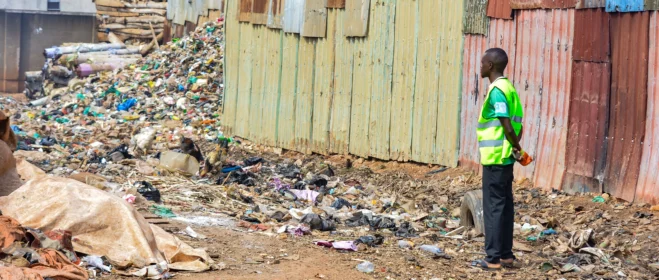
Uganda has spent years trying to restrict disposable plastic bags, yet plastic continues to accumulate in its streets, farmland, wetlands, and waterways. According to the country’s National Environment Management Authority (NEMA), Uganda generates more than 600 metric tonnes of plastic waste every day, and less than 40 percent is properly collected and managed.
That gap between policy and reality is what Chris Ssali is working to close. A chemistry laboratory technician turned climate activist and circular economist, Ssali leads Umoja Kwa Haki Ya Tabianchi — United for Climate Justice Uganda — and works with young people to challenge plastic pollution, fossil fuel subsidies, and the systems that allow environmental damage to continue without accountability.
On the JET Voices podcast, he explains how witnessing industrial chemicals enter community water systems pushed him into environmental advocacy, why recycling cannot keep pace with the production of virgin plastic, and how grassroots enterprises are turning discarded bottles into useful products and local income.
What plastic pollution looks like on the ground
In Uganda, plastic pollution is not confined to landfills. Lightweight bags, bottles, packaging, and other discarded products enter drainage channels, wetlands, farmland, and water bodies such as Lake Victoria.
The consequences become especially visible during heavy rain. Plastic and other solid waste obstruct urban drainage systems, reducing their capacity to carry stormwater and contributing to recurrent flooding. In Kampala, NEMA has identified single-use plastics as one of the materials routinely choking drainage channels and degrading wetlands.
The problem is also spreading beyond the capital. An Associated Press investigation into agricultural plastic pollution documented plastic bags appearing in farmland around Uganda’s Mbale district, including plastic used in coffee nurseries. As larger plastics break down, fragments can remain in the soil and travel through water systems.
For Ssali, this visibility is one reason plastic became a central focus. People may not immediately see the carbon emissions associated with fossil fuel extraction or industrial production, but they can see bottles floating in rivers, bags caught in vegetation, and waste blocking the channels around their homes.
The industrial experience that changed his direction
Ssali trained as a chemistry laboratory technician and worked in industries producing cosmetics, skincare products, and pharmaceuticals. In a country where employment opportunities can be limited, the work gave him a chance to use the scientific education he had fought hard to obtain.
But inside the production process, he began to question what happened to the chemicals after they left the laboratory. He describes seeing chemical mixtures discharged into sewer systems that eventually connected with wetlands and community water sources.
The experience forced him to reconsider the relationship between his profession and the environment. Chemistry itself was not the problem. The problem was an industrial culture that pursued production and profit while treating pollution as an external cost for surrounding communities to absorb.
“Planet first, then profit comes next.”
Ssali did not abandon science. Instead, he began using his technical understanding to advocate for safer production, stronger environmental rules, and greater public awareness. His work gradually expanded from chemical pollution and tree planting to deforestation, single-use plastics, fossil fuel subsidies, and climate justice.
Why Uganda’s previous plastic restrictions have failed
Uganda’s plastic crisis is not the result of having no environmental rules. The country has repeatedly attempted to restrict plastic carrier bags, locally known as kaveera.
The existing legal approach prohibited the manufacture, importation, and use of plastic carrier bags below 30 microns. In practice, however, enforcement officers found it difficult to distinguish between bags of different thicknesses, while prohibited products continued to be manufactured, imported, or sold.
Previous enforcement attempts in 2007, 2009, 2015, 2018, and 2021 either collapsed or were implemented inconsistently. The result is a familiar gap between what is written in policy and what remains freely available in shops and markets.
In June 2026, NEMA announced that it had finalised a new draft Bill seeking a clearer ban on problematic single-use plastics. According to the Daily Monitor’s reporting on the proposed law, the Bill was awaiting presentation to Parliament and would replace the difficult micron-based distinction with broader restrictions on disposable plastic products.
The same report cites NEMA statistics showing that Uganda produces more than 600 metric tonnes of plastic waste daily, with approximately 60 percent left uncollected or improperly managed.
For Ssali, passing another law will only matter if it is accompanied by enforcement, affordable alternatives, better collection systems, and accountability for the companies placing plastic products on the market.
Turning discarded bottles into a local economy
Ssali’s response is not limited to campaigning for new laws. He has also helped develop a social enterprise that collects discarded plastic bottles and turns them into products such as waste bins, baskets, and household items.
The idea treats plastic waste as a raw material rather than something with no remaining value. Waste is collected before it reaches waterways or drainage systems, transformed into a new product, and returned to the local economy.
The business also creates a practical connection between climate action and livelihoods. Instead of asking communities to choose between environmental protection and income, circular enterprises can use the same activity to address both.
But building that market is difficult. Ssali says consumers often perceive products from established factories as more reliable than goods made by youth-led recycling enterprises, even when the locally made product creates a clear environmental benefit. Small recyclers must compete with companies producing new plastic at a much larger scale and often at a lower cost.
Uganda’s own National Strategy for Promoting Plastics Circularity 2023–2028 recognises this imbalance. The strategy identifies three priorities: expanding reuse, making plastic recycling more stable and profitable, and developing sustainable alternatives to disposable plastic products.
The strategy also supports extended producer responsibility, under which companies share responsibility for collecting and managing the packaging and products they introduce into the market. That could shift part of the financial burden away from municipalities, communities, and informal collectors and back toward producers.
Why recycling alone cannot solve the problem
Recycling can recover useful materials, reduce the volume of waste entering the environment, and support jobs. But Ssali argues that it cannot solve the crisis while the production of new plastic continues growing.
Virgin plastic manufacturers operate at a scale that small recycling enterprises cannot match. When new plastic remains cheap and widely available, recycled materials must compete against a constant stream of products designed to be used briefly and discarded.
Uganda already has companies recycling PET, polyethylene, and polypropylene, with PET bottles among the most commonly recovered materials. But collection remains fragmented, and a large share of potentially recyclable waste never reaches a processing facility. The Global Green Growth Institute’s research into Uganda’s plastic economy found that improving recycling requires more than processing plants: it also depends on collection systems, separation at the source, markets for recycled materials, and incentives that make circular businesses financially viable.
For Ssali, the solution must therefore work at both ends of the system. Communities need better collection and recycling infrastructure, but governments must also reduce unnecessary single-use plastics and make producers accountable for what happens after their products are sold.
Without action upstream, recycling becomes an attempt to empty a flooded room without turning off the tap.
Plastic is also a fossil fuel issue
Plastic pollution and the energy transition are often treated as separate environmental debates. Ssali sees them as parts of the same system.
Most conventional plastics are produced from fossil fuel feedstocks. Continued investment in oil and gas therefore supports not only fuel production but also the expansion of petrochemicals and virgin plastic.
Through United for Climate Justice, Ssali participates in the international Stop Fossil Subsidies campaign, a coalition of climate justice movements calling on governments to end public support for fossil fuel production and consumption.
The scale of that support remains enormous. The OECD and International Energy Agency estimate that the fiscal cost of global fossil fuel support was approximately $916 billion in 2024. Although that represented a decline from the exceptional support introduced during the global energy-price crisis, the total remained high compared with historical levels.
Ssali argues that these subsidies work against a just transition. Governments continue using public resources to protect fossil fuel production while grassroots renewable-energy projects, recycling enterprises, and climate organisations struggle to obtain funding.
Removing those subsidies would not automatically finance every community initiative. But it would address a central contradiction: governments cannot claim to be moving away from fossil fuels while continuing to make them economically easier to produce and consume.
The fight for a binding Global Plastics Treaty
This conflict between production and waste management is also at the centre of negotiations for a Global Plastics Treaty.
In 2022, United Nations member states agreed to develop a legally binding instrument addressing the full life cycle of plastic, including its production, design, chemical content, consumption, and disposal.
A strong treaty could establish common rules for reducing unnecessary plastic production, controlling chemicals of concern, designing reusable and recyclable products, and holding manufacturers responsible for their plastic footprint. It could also create financing mechanisms to help lower-income countries improve collection, recycling, regulation, and enforcement.
For grassroots enterprises in Uganda, that financing could help expand collection networks, purchase processing equipment, train workers, and create stable markets for recycled materials. For governments, a binding international agreement could provide a stronger legal foundation for demanding action from multinational producers.
But the treaty remains unfinished. Negotiations held in Geneva in August 2025 ended without consensus on a final text. The most divisive issues included limits on plastic production, controls on harmful chemicals, financing for implementation, and whether the treaty’s most important provisions should be legally binding.
One group of countries wants the agreement to address plastic across its entire life cycle, including how much is produced. Oil- and petrochemical-producing states have generally pushed for a narrower agreement focused primarily on waste management and recycling.
In February 2026, negotiators reconvened for INC-5.3 and elected a new chair, but no substantive negotiations took place. As of August 2026, the United Nations process is continuing through informal meetings in preparation for INC-5.4.
For Ssali, a treaty focused only on managing waste would leave the central problem intact. Communities cannot recycle their way out of plastic pollution if production continues expanding faster than their ability to collect and process it.
Building climate leadership from lived experience
Ssali’s commitment to youth organising comes from his own experience of having to build a future with limited resources.
He grew up in a rural Ugandan community deeply affected by the country’s past conflicts. As a child, he remembers encountering human remains while farming land where people had died during the war.
At around ten years old, he moved toward Kampala in search of education and essential services. He describes fetching water, carrying luggage for money, and combining school with whatever work was available. He originally hoped to become a doctor so he could address the lack of healthcare in his home community, but a government scholarship eventually led him to study chemistry.
That training gave him another way to protect people: understanding environmental hazards, explaining risks that are often invisible to the public, and challenging the systems that allow pollution to reach marginalised communities.
“A dying planet cannot sustain living people.”
Today, Umoja Kwa Haki Ya Tabianchi works with students and volunteers to develop more community organisers, environmental educators, researchers, and political advocates. The goal is not simply to build one successful organisation. It is to create a generation capable of identifying local problems, demanding accountability, and developing solutions that communities can operate themselves.
Hear the full conversation
Plastic pollution is the entry point, but Ssali’s story is ultimately about persistence: moving from rural hardship to scientific training, from witnessing industrial pollution to confronting it, and from advocacy to creating useful products out of discarded waste.
On JET Voices, he explains why East Africa needs stronger enforcement of plastic laws, how fossil fuel subsidies obstruct a fair transition, what a binding Global Plastics Treaty could offer frontline communities, and why youth-led initiatives need meaningful investment if they are expected to compete with the industries driving the crisis.
🎧 Listen to “Youth for Change” with Chris Ssali →
Want more stories from the frontlines of a fair energy future? Subscribe to the JET newsletter and explore our climate justice blog.
Further reading
National Strategy for Promoting Plastics Circularity in Uganda 2023–2028 – National Environment Management Authority of Uganda
“Sixth time lucky? NEMA moves to enact total plastic ban amid Kampala flooding woes” – Daily Monitor
Global Plastics Treaty negotiations – United Nations Environment Programme
“Can Uganda end plastic pollution?” – Global Green Growth Institute
Fossil fuel support data – OECD
Stop Fossil Subsidies – United for Climate Justice